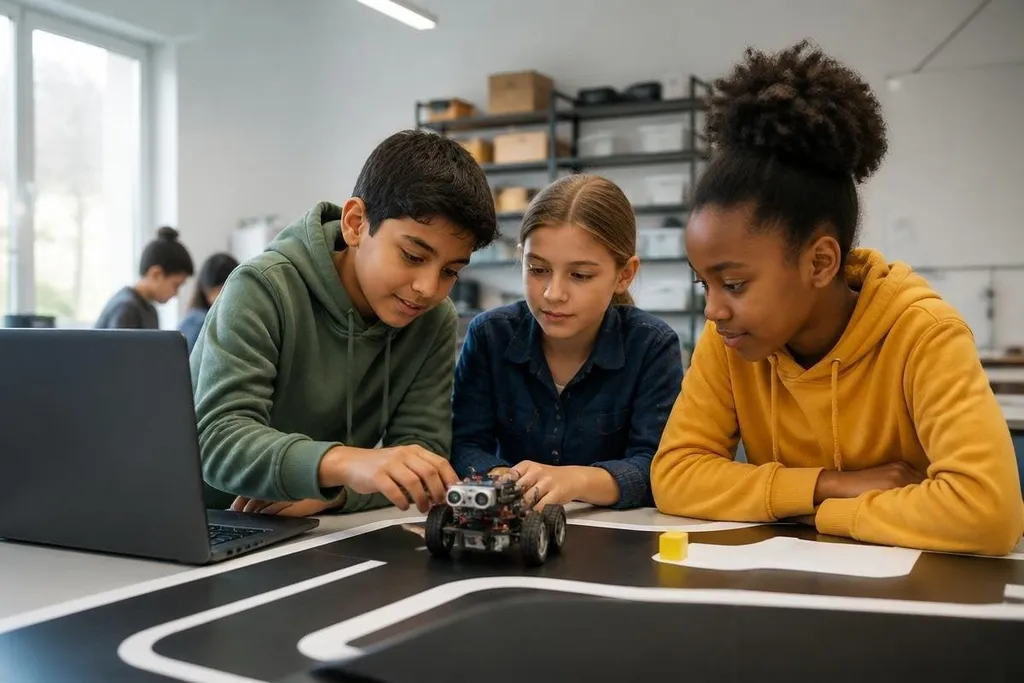
Robotics classes are moving beyond specialist labs. Schools now use small robots, motors, sensors, and code to teach ideas that students can see working in front of them.
That shift matters to a school leader deciding where to spend limited time and money. Robotics can connect science, technology, engineering, and mathematics in one task, but the hardware alone doesn't make a good lesson.
Quick read
- Robots turn code into visible movement, which helps students link an instruction to a result.
- A useful class needs clear learning goals, safe equipment, teacher support, and time to test designs.
- Growth is hard to measure worldwide without shared data on enrollment, budgets, and course names.
Why schools are adding robotics
Robotics gives students a physical result to inspect. A program can tell two motors to turn, while a distance sensor can detect an object and change the robot's movement. The student sees the result, checks the code, and tries again.
That loop brings a basic programming idea into the room: instructions cause actions, and errors leave visible clues. A student who changes one line of code can watch a robot stop, turn, or move farther, then connect the result to the change they made.
The subject also joins several school subjects in one project. Students may need arithmetic to measure distance, physics to think about force, design skills to build a frame, and programming to control the motors. The robot gives those lessons one shared task.
The link between school and work
Companies use automation in factories, warehouses, farms, hospitals, and laboratories. Students don't need to operate industrial equipment in class to learn the basic ideas behind it.
They can work with a microcontroller, a motor driver, a camera, or a simple gripper at a safer size.
This gives schools a way to teach skills used in robotics jobs without claiming that a classroom robot matches a production system. Industrial robots need safety systems, maintenance, network controls, and careful testing. A classroom kit covers a small part of that work.
A sensor lesson becomes easier to explain when students can see the same idea in a working robot. For industry readers, Robot 24 can link that classroom task to the companies and machines students may meet in later training or work.
Why growth looks different by country
Robotics education doesn't follow one model. One school may run a weekly club with shared kits. Another may add robot tasks to physics or computer science. A technical college may teach robot arms, machine vision, and industrial safety with equipment closer to factory systems.
Money is only one limit. Teachers need time to learn the software, repair parts, plan lessons, and manage groups around moving equipment. Internet access, power supplies, local language support, and course rules also shape what a school can run.
The global claim needs care. Without a shared count of robotics courses, student numbers, and school budgets, it isn't possible to state a worldwide growth rate from the information supplied here. The reasons for expansion are clear, but the size of that expansion needs dated local evidence.
What a useful program needs
A school deciding on robotics education can check these points before buying equipment:
- Lesson goal: Name the science, coding, or design skill students should show by the end.
- Robot type: Match the kit to the task, such as wheeled movement, sensing, or arm control.
- Teacher time: Set aside time for software setup, repairs, and lesson planning.
- Student access: Count how many students can build and test instead of watching one robot.
- Safety plan: Cover moving parts, batteries, charging, storage, and an emergency stop.
- Success test: Use a short task that shows what students learned without rewarding costly equipment.
I'd fund teacher support before buying a larger fleet. Ten robots with weak lessons will teach less than four robots used well by prepared teachers.
The next useful measure is local: record course numbers, student attendance, teacher hours, equipment costs, and skills taught for one school year. Those records can show whether robotics education is growing in a way that helps students, rather than counting purchases as progress.